Executive Summary
The paper examines violent extremism in Pakistan and the role of human rights education, arguing that universities can help develop tolerance, peaceful coexistence, and resistance to extremist ideas.
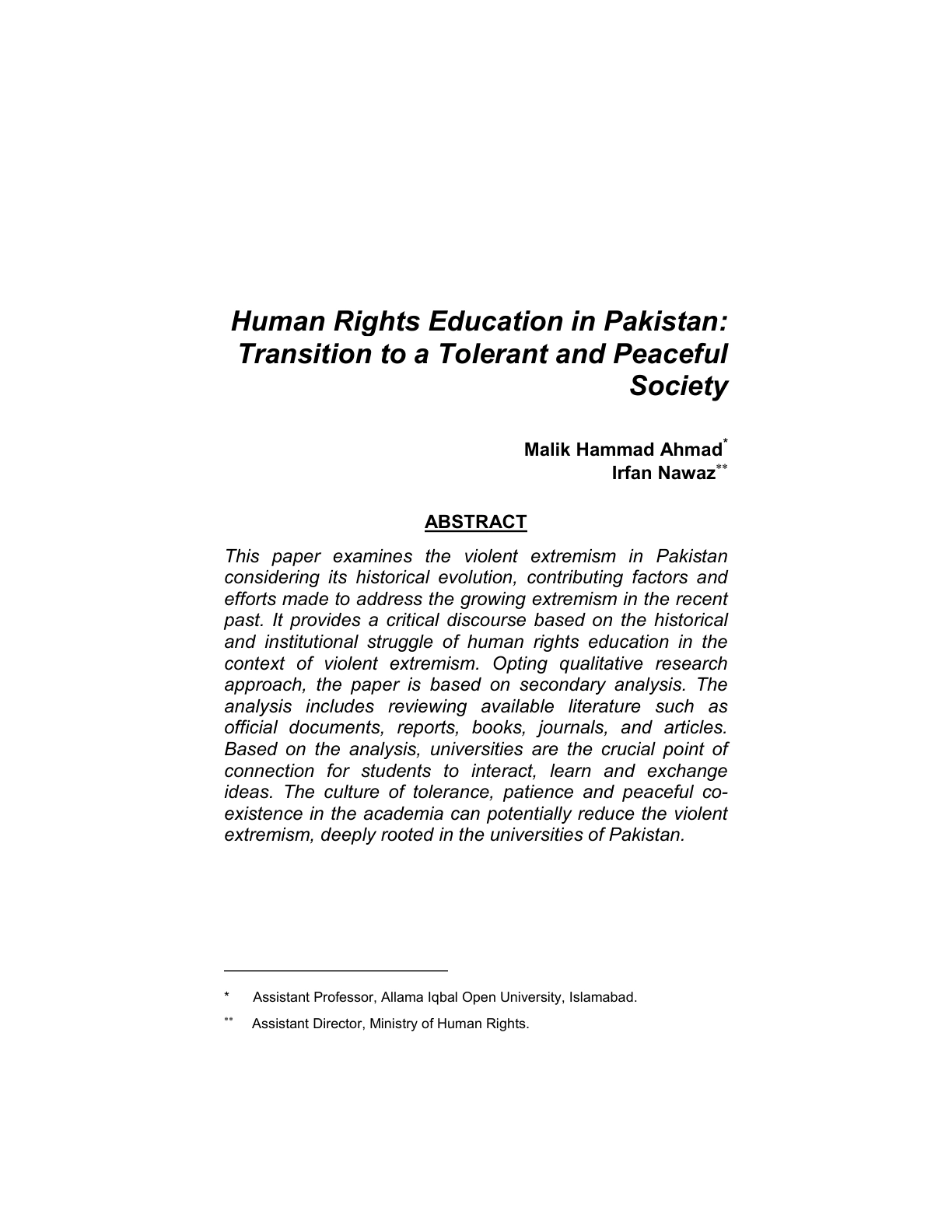
The paper examines violent extremism in Pakistan and the role of human rights education, arguing that universities can help develop tolerance, peaceful coexistence, and resistance to extremist ideas.

The paper examines the process of lawmaking in Pakistan at both federal and provincial levels. It explains procedures for passing ordinary laws, constitutional amendments, ordinances, and bills through Parliament and provincial assemblies. It also discusses the role of parliamentary standing committees and the constitutional limits on Parliament’s power to amend the Constitution.
At the Margins of Protection: Child Labor in Pakistan’s Private Sector examines the persistence of child labour within Pakistan’s private-sector economy, particularly in informal sectors and lower levels of supply chains where children remain largely outside formal protection and oversight. The report identifies poverty, limited access to education, weak enforcement of labour laws, fragmented data systems, inadequate labour inspection, and poor coordination between federal and provincial institutions as major factors contributing to child labour. It draws on legal and policy reviews, consultations across Pakistan, and interviews with relevant stakeholders. The report highlights that an estimated 8.6 million children are engaged in child labour in Pakistan and emphasizes the hazardous and hidden nature of much of this work. It calls for a coordinated, systems-based response involving stronger labour inspections, improved data systems, harmonized legal standards, education retention, social protection, livelihood support, and greater accountability of private-sector actors.
The report Women at Work: Closing the Gap, launched jointly by the European Union, the National Commission on the Status of Women (NCSW), and the United Nations Development Programme (UNDP), examines gender inequality within Pakistan’s private sector and proposes practical reforms to improve women’s economic participation. Despite progress in education and skills development, women’s labour force participation remains around 30 percent, while the gender pay gap exceeds 20 percent. Women remain disproportionately concentrated in low-paid, informal, insecure, and low-authority employment. Drawing on nationwide consultations, interviews, and an assessment of workplace policies and institutional frameworks, the report identifies major barriers to women’s entry, retention, and advancement, including workplace harassment, limited leadership opportunities, weak implementation of gender-responsive policies, and inadequate protections for informal workers. It recommends coordinated reforms in labour governance, workplace protection, leadership development, supply-chain accountability, worker infrastructure, entrepreneurship, and access to remedies. Overall, the report argues that advancing gender equality is essential not only to protecting women's rights but also to achieving inclusive economic growth and sustainable development in Pakistan.
This article explores the historical trajectory of women’s movements in the Indian subcontinent, with a focus on pre and post partition of the sub-continent in 1947. It traces early feminist mobilization within anti-colonial and social reform contexts, followed by the emergence of new challenges in post-Partition nation-states. In Pakistan, the institutionalization of patriarchal norms, particularly under the Zia regime through laws such as the Hudood Ordinances, marked a significant regression in women’s rights. This article focuses on the resistance led by feminist activists and civil society organizations in the face of repression by the state, religious authorities, and conservative media. Despite systemic obstacles, women’s movements have demonstrated resilience and adaptability, continuing to advocate for legal reform, bodily autonomy, and gender equity.